
Most homes cover a cat's food, water, and affection and still miss the three things that drive daily behavior: enough litter boxes in the right places, height to climb, and real outlets for hunting instincts. When one of those is short, your cat shows you instead of telling you: a puddle on the bath mat, tension with a housemate, whole afternoons under the bed. Stress from a crowded or badly arranged home does not stop at behavior either, since it can wake a dormant upper respiratory virus or set off urinary signs that need treatment rather than a new cat tree. The size of your home matters far less than how it is arranged, and most of that is a weekend project, but straining in the box, sneezing that will not clear, or producing little or nothing belongs in front of a veterinarian that day, especially in a male cat.
Valley Center Veterinary Clinic sees the repercussions of cats that aren’t getting what they need in their environment, and it shows up as behavioral and medical problems. As an AAHA-accredited hospital, we examine your cat and recommend the diagnostic testing that separates a urinary or respiratory cause from an environmental one before anyone rearranges furniture. Once your cat is medically clear, we go through box count, placement, and climbing options with you, and our adult cat wellness plan builds in the annual exam where most of those conversations start. If your cat's habits have changed, get them on our schedule.
Cat Home Setup Basics
- Box count, climbing routes, and hunting outlets run a cat's day, and arrangement beats square footage.
- One litter box per cat plus one, spread across the home instead of lined up in one bathroom.
- Height gives a cat territory without using floor space.
- A cat who starts missing the box, overgrooming, or hiding needs an exam first, since urinary disease and pain can look like a behavior problem.
If you're wondering whether your cat can be happy in a small apartment, the good news is that indoor cat enrichment depends far more on how a home is set up than on how big it is. Your cat doesn't need a mansion or a jungle gym to feel fulfilled. Walk through your space with four questions in mind:
- Are the basics covered? Fresh food, easy access to water, and enough clean litter boxes in quiet spots.
- Do their instincts have an outlet? Something to scratch, toys to stalk, and daily play that ends in a catch.
- Is there both height and a place to hide? A shelf or perch up high, plus a box or covered bed to retreat to.
- Is there work for the brain? Short training sessions, food puzzles, and new smells burn mental energy too.
Most of the fixes take an afternoon and cost very little.
How Many Litter Boxes Does Your Cat Need?
Your cat needs one box per cat in the house plus one, so a two-cat home needs three. Size counts as much as number: a litter box about one and a half times the length of your cat from nose to tail base. Cats don't reliably share, so one box can be guarded while the other is dirty, leaving nothing acceptable at the moment it's needed.
Which Litter Box Should You Buy?
Style matters less than size, but each design has trade-offs.
| Box style | Best for | Trade-off |
| Open pan | Most cats, multi-cat homes | Scatter, no privacy |
| Covered | Scatter control, shy cats | Holds odor, cramped, easy to corner a cat |
| Top-entry | Enthusiastic diggers, keeping dogs out | Hard on stiff or heavy cats |
| Storage tote, cut low | Large cats who need length | You cut the entry yourself |
Where Should the Boxes Go, and What Litter Goes In Them?
A box beside the washing machine is ruined the first time the spin cycle startles a cat mid-squat, and one next to the food bowls asks your cat to eat in their own bathroom. Spread them across rooms and onto every floor your cat uses, so a stiff senior never has to take stairs to reach one. Most cats prefer cat litter that's unscented, fine-grained, and clumping, filled two to three inches deep.
Scoop daily, and wash the pan with mild soap when you change the litter. A box that isn't clean enough shows up gradually: a cat perching on the rim, then going beside the box, then on the bath mat. Urine testing comes before any rearranging, since stress-driven cystitis can start as nothing more than a cat who stopped using the box and can block a male cat overnight.
Why Does Your Cat Want to Be Up High?
Height means safety, a lookout, and a spot no housemate can claim, and in a small apartment it's the cheapest square footage you have. Wall-mounted cat shelves and hammocks add territory without using any floor, and you don't have to buy a tower to get it: clearing the top two shelves of a bookcase or screwing a sisal-wrapped board into studs at staggered heights does the same job. Nothing should wobble, since one bad landing teaches a cat the route isn't safe, and carpet or sisal gives an older cat's back feet something to grip.
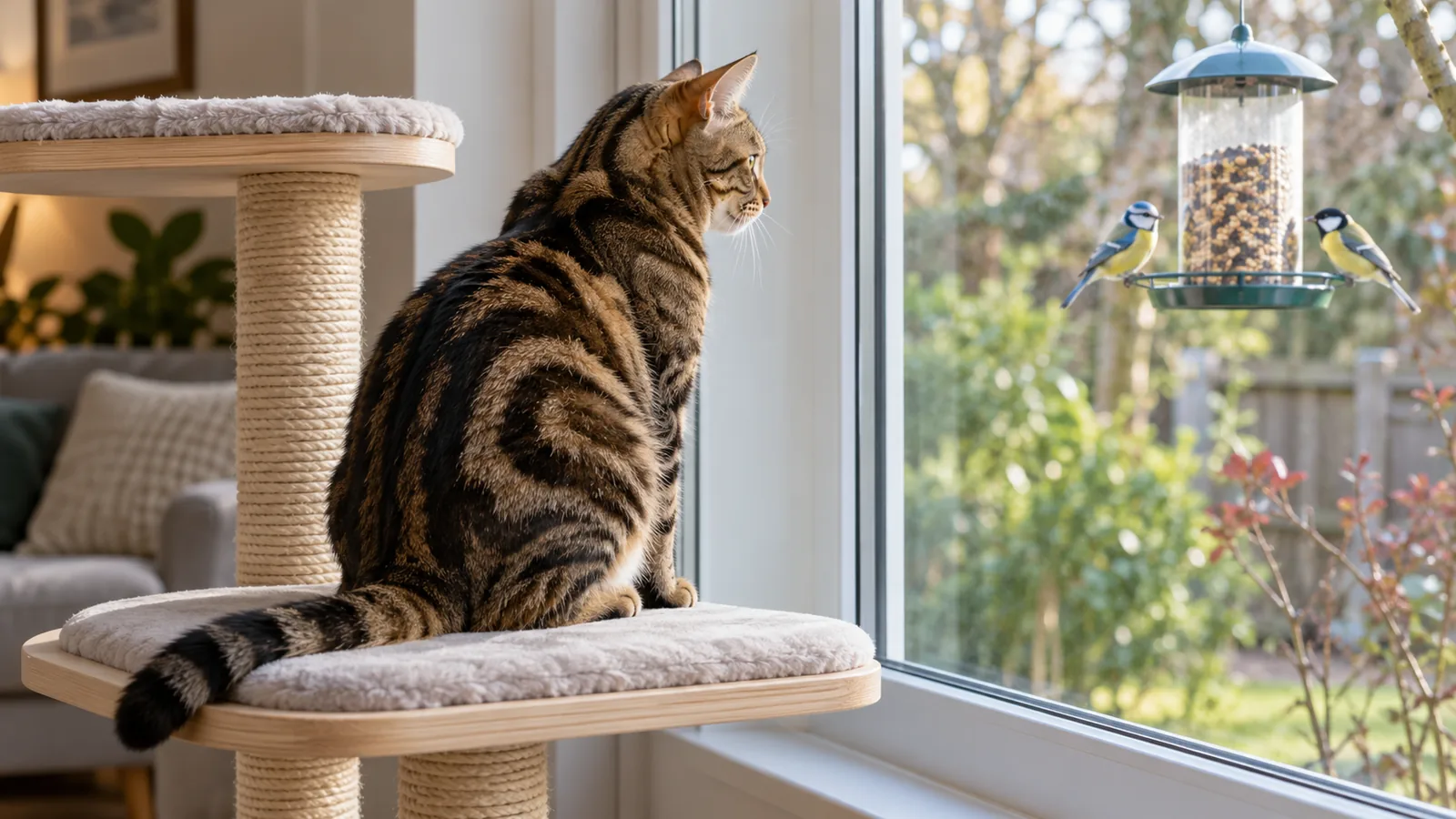
A window perch with a bird feeder in view adds live entertainment, and chattering at the glass is normal hunting excitement. A cat who can't reach the birds sometimes turns that frustration on a housemate, though, so cover the lower pane for a while if window watching ends in fights.
What Does Enrichment Look Like in an Apartment?
Domestication didn't remove the drive to hunt, stalk, climb, and scratch, so an indoor cat with no outlet picks their own target: your ankles at 3 a.m. or the arm of the couch.
How Should You Play With an Indoor Cat?
Hunting behavior runs as a set sequence of stare, stalk, chase, pounce, and catch, so play that never ends in a catch leaves the pattern unfinished. The dot from a laser pointer can never be caught, so end every session by landing the light on a real toy. Drag a wand toy away and let it vanish behind a chair, since real prey flees rather than charges. Stop before a lashing tail, rippling skin along the back, or ears turning sideways tips play into biting. Two short sessions beat one long one, a toy left out all week stops looking like prey, and a few treats at the end close the sequence.
Which Cat Toys Are Dangerous?
String, ribbon, tinsel, and hair ties are linear foreign bodies that bunch the intestine along them, a surgical problem, so a cat who's vomiting, hiding, and off food after chewing thread needs to be seen that day. Never try to make your cat vomit, and never pull on anything you can see at the mouth. We handle emergencies and urgent care during our open hours, and an X-ray or ultrasound can show whether the thread is moving or stuck.
How Do Food Puzzles Help an Indoor Cat?
Food puzzles, slow feeders, and treat-dispensing balls turn one meal into a hunt, and splitting the daily ration across several stations gets a sedentary cat moving. You don’t need to buy anything fancy. Paper towel rolls, egg cartons, and cardboard boxes are perfect for homemade food puzzles. Canned food adds water that supports the urinary tract, while most puzzle feeders are built around dry kibble, so many households do some of each.
Scattering a few kibbles across the floor is a hunt with no equipment at all, and a snuffle mat hides food in fleece strips for your cat to nose out. A lick mat spread thin with wet food keeps a cat busy during nail trims and brushing. Count all of it toward the daily ration, wash mats after use, and pick up any your cat starts chewing. In multi-cat homes, give each cat their own feeding station.
What Else Adds Variety, and What Should Stay Out of Reach?
Catnip response is inherited, kittens under about six months rarely react, and roughly a third of adult cats ignore it. Scent games with silver vine, valerian, or hidden treats work for the ones who ignore it. Fresh scents from the outdoors work, too; a pinecone, feather, or a small sprig of fresh herbs like basil, lemon balm, or cilantro go a long way. Skip essential oils, which are toxic to cats whether diffused, applied, or licked off a surface, and keep strong fragrances away from cats with asthma.
Outdoor time is also a valuable way to add some fun to their day. A screened catio or harness training that starts indoors adds new input without the risks of roaming. Be sure their parasite prevention is current, they're microchipped, and windows and balconies are secure. Keep them from chewing outdoor plants. Lilies can cause kidney failure from the pollen alone, so any lily exposure is an emergency.
Where Should Your Cat Scratch?
Scratching conditions claws, stretches the back and shoulders, and leaves a scent mark, so a cat without a good surface uses a bad one. Redirecting destructive scratching means putting an acceptable post directly beside the spot your cat already chose, rewarding every use, and making the old surface less inviting with double-sided tape or a sheet of plastic. Offer more than one kind, since a cat who wants a full vertical stretch on sisal won't settle for a flat cardboard pad. Nail trims every few weeks keep the damage down, and soft vinyl claw caps are an option for a determined cat. Declawing amputates the last bone of each toe and is linked to chronic pain, house soiling, and biting, so we don't recommend it.
Can You Train a Cat?
Cats can be trained, and training is mental work that counts as enrichment. They learn quickly with positive reinforcement in sessions of three to five minutes, while punishment teaches a cat to hide from you and leaves the behavior untouched. A clicker or a marker word tells your cat the exact instant they got it right, and the treat follows, so start with something they already do, like a sit or a nose touch to your hand.
What Is Cooperative Care, and Why Does It Matter at the Vet?
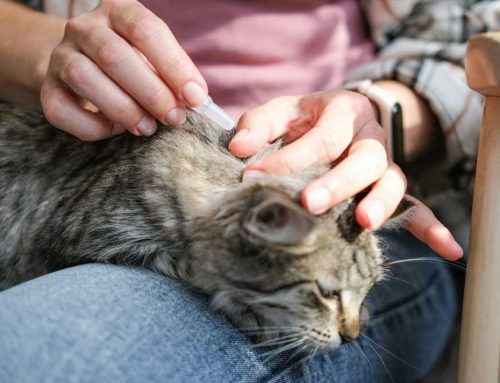
Cooperative care is some of the best training you can do. It teaches a cat to volunteer for handling instead of enduring it, so a paw hold, an ear check, a pill, or the carrier becomes something your cat opts into. Touch a paw, click, treat, stop, then hold it a second longer tomorrow. Leave the carrier out year-round with a towel and snacks inside so it stops being the thing that appears right before a car ride. Kittens pick this up fastest, and kitten visits are a good place to practice handling with us.
How Do You Keep the Peace in a Multi-Cat Home?
Peace in a multi-cat home comes from resources more than personality: enough boxes, separate food and water stations, enrichment and toys that keep them busy, and enough height that no cat has to cross another's space. Some cats love having a buddy; others prefer life solo.
A pheromone diffuser can take the edge off during a rough stretch, like a move or a new cat, though it works alongside the resource changes rather than in place of them. The cat who suddenly starts picking fights, or gets picked on, may be the one who doesn't feel well, so an annual exam for everybody in the house beats guessing which one that is.
What Do Your Cat's Tail, Ears, and Purr Mean?
Cats talk with their bodies, and the meaning sits in the combination rather than any one signal. Purring isn't only contentment, since pain, anxiety, and hunger can all produce the same sound, so read the tail, ears, and eyes alongside it. A tail straight up with a soft hook at the tip is a cat pleased to see you, while flattened ears, wide pupils, and a low lashing tail want room instead of attention.
What matters most is change: a cat who used to meet you at the door and now stays under the bed might be reacting to a new dog next door, or hiding a sore tooth, experiencing arthritis pain, developing kidney disease, or has eaten a toxic plant. Gradual changes over weeks mean you should schedule an appointment; sudden changes, especially with changes in appetite, urination, vomiting or diarrhea, or signs of pain, mean coming in for emergency care.
When Is a Behavior Change a Medical Problem?
A shift in habits is one of the few ways a cat can report that something hurts, so an exam comes first. House soiling, aggression, overgrooming, and sudden hiding are the most common cat behavior problems, and every one has medical causes that belong on the list before a behavior plan starts.
- Litter box avoidance: Straining, frequent trips, blood in the urine, or producing little or nothing points at the urinary tract, and a blockage in a male cat is a same-day emergency.
- Overgrooming: A bald strip on the belly or inner thighs can be fleas, allergies, or pain rather than stress, so the skin gets examined before the household does.
- New overnight vocalizing: Yowling in the small hours from an older cat can be hyperthyroidism, high blood pressure, or cognitive decline, and we start with bloodwork.
- Won't be touched: Pain often explains a cat who suddenly objects to handling, and a mouth exam with dental X-rays finds the likeliest source.
When the exam comes back clear, we look at what changed at home, since moves, construction, a new baby, another cat, a schedule shift, or wildlife visible through a Valley Center window all show up in behavior first. Anything that's lasted more than a few days, or any change in how your cat uses the box, deserves a look. Give us a call and we'll examine your cat and go through the household with you.
What Should Change Around the House as Your Cat Ages?
Night vocalizing, disorientation in familiar rooms, and skipped grooming are the behavior changes in older cats most often written off as aging, when they often trace back to arthritis pain, fading senses, or cognitive decline.
- Lower entry: A pan with a two-inch opening, or a tote cut down on one end, saves a stiff cat the step over a six-inch wall.
- Closer boxes: An extra box on the same floor as the favorite sleeping spot matters far more at thirteen than it did at three.
- Steps up: A padded stool beside the bed or a ramp to the window perch keeps an older cat using the heights they still want.
- Warmth and grip: Heated bedding and a runner over slick floors help sore joints and back feet that slide.
- Light and routine: A dim hallway light and a predictable feeding schedule settle an anxious senior whose eyesight is fading.
Arthritis in cats rarely starts as a limp. A cat with sore joints stops jumping to the counter, takes the stairs one at a time, picks a new napping spot on the floor, and limps only later, slowly enough to look like a change in personality. Senior wellness care is where that pattern gets caught, and X-rays show how much arthritis is in the joints. Comfort usually comes from some mix of medication, joint support, or cold laser therapy.
Common Questions About Litter Boxes, Second Cats, and Small Apartments
Is My Cat Peeing on the Bed Out of Spite?
Cats don't soil out of revenge. A cat who picks your bed is usually telling you the box hurts to use, feels unsafe, or isn't clean enough, and a soft absorbent surface is the easiest substitute. Urinary disease sits at the top of that list, so the first step is a urine sample, not a new box.
Will a Second Cat Fix My Cat's Boredom?
A second cat sometimes helps and sometimes creates a second problem. A confident young cat may welcome a playmate, while a territorial adult who's been solo for eight years may not. Add the resources before you add the animal: extra boxes, separate feeding stations, and climbing options in shared rooms. Then introduce slowly, through a closed door and scent swaps, over weeks rather than an afternoon.
How Small Is Too Small for a Cat?
Studio apartments work for cats, and so do single rooms, as long as the height and resources are there. Your cat needs a safe high spot, a quiet box away from food, something satisfying to scratch, and a few short hunts a day. A 400-square-foot apartment with shelves and a window perch offers more usable room than a large house with bare walls and one box in the garage.
A Home That Works for Both of You
Valley Center Veterinary Clinic is glad to go through your setup, whether you're adding a second cat, working through a behavior problem, or getting ready for a kitten. Book a visit and we'll rule out the medical half first, then talk through the rest of the house.